
Camp
  • Darn Tough | The Story

    The socks that saved a Vermont factory from bankruptcy – and built a brand with the best lifetime guarantee in the entire outdoor industry.

    Two pairs of feet in Darn Tough wool hiking socks kick up through a shower of autumn leaves in Vermont.

    4th August 2026 | Words by Matt Jones @ WildBounds HQ


    In the early 2000s, Ric Cabot was a man on the edge. He was running his family’s sock mill in Northfield, Vermont, and watching it die. The creditors were closing in. His father Marc, who’d originally built the business from the ground up, was facing the same spiralling debts. Something needed to change, and fast. Ric decided to pivot, betting the business on a new approach, a new direction – and a new name. He didn’t reach for something aspirational. He reached for the truth. “I thought we were darn tough if we could survive,” he remembers. It was a good pun, but it was also a prayer.

    Third Generation, Same Knitting Floor

    Hosiery runs in the Cabot family the way farming runs in some families – it’s just what you do. Marc Cabot’s own father had run sock mills in New Hampshire and North Carolina, so when Marc struck out on his own in the mid-1970s, he already knew knitting machines like a farmer’s son knows tractors. The money to start the mill came from an unlikely place: on holiday in Aruba in 1967, Marc got talking to a stranger at the craps table who turned out to be Norman Barron, founder of the Marshall’s department store chain. The friendship stuck, and Barron put up half the capital to buy a derelict fleece factory in Northfield – chosen, more or less, because it was the only building nearby that could take the weight of the big, heavy knitting machines. For years the mill produced hosiery for other big US labels: GAP, Banana Republic, Old Navy, Talbot’s, Brooks Brothers, Ralph Lauren Polo. Despite the stellar client list, it was steady, unglamorous, low-margin work.

    Marc Cabot, founder of Cabot Hosiery Mills, and his son Ric Cabot, Darn Tough’s CEO, stand arm in arm on the Northfield, Vermont knitting floor, surrounded by hundreds of hanging yarn spools

    Two generations, one mill, more yarn than either of them can count: Marc and son Ric on the modern-day knitting floor.


    Ric joined in 1989, aged 25, leaving a career in publishing to start – like his father before him – on the knitting-room floor, checking product for quality by hand. He bought out Barron’s stake in 1994, bringing the mill under Cabot family ownership outright, and for a while business carried on the way it always had. Then, as Ric puts it, came “the giant sucking sound” of American manufacturing moving offshore. Cabot’s biggest clients pulled their contracts. The workforce shrank from dozens to 35. Production dropped to three days a week. With a child on the way and the banks circling, Ric found himself needing, in his words, “something relevant and profitable” – fast. “From the hottest of fires,” he’s said of that period, “comes the strongest of steels.”

    Two hikers sit on a Vermont cabin porch in Darn Tough wool socks, boots resting beside them after a day on the trail, one wearing a Northfield Town Hosiery Department t-shirt.

    Boots off, job done. Today, Darn Tough socks clad the feet of hikers from New England to New Mexico and beyond – but the journey to get here was a long and difficult one.


    A Marathon Gamble

    The idea that saved the mill wasn’t subtle: build a sock so good, and back it with a guarantee so ironclad, that people would pay triple the price of a supermarket three-pack and never think twice. Ric designed a merino wool sock with a sculpted heel, a fitted toe box and an unusually high stitch count – dense rather than bulky, built for people who, as he puts it, “demand a lot of their gear.” In 2004, with almost nothing left to lose, he filled a backpack with the first Darn Tough socks and talked his way onto a shelf at a retailer ten miles down the road in Montpelier. Then he gave away 3,500 pairs to runners at the Vermont City Marathon in Burlington.

    The original Darn Tough running sock from 2004, a cream quarter-crew style with a navy cuff and mountain logo, shown on a plain background

    The OG marathon running sock from 2004 – the one that started it all, unchanged in all the ways that matter. Apparently, some pairs are still going strong today.


    Word of mouth did the rest. Runners who’d never paid for a branded sock before found themselves telling other runners about socks that didn’t blister, didn’t bunch, and – this was the part that made people talk – came with a lifetime guarantee. Wear a hole in them, any time, for any reason, and Darn Tough replaces the pair. No receipt, no argument. It also did something cleverer than generosity: it reframed the price. A twelve-pack of imported tube socks might cost less than a single pair of Darn Tough, but as Ric points out, “you can make the argument that if I buy one pair of socks at $20, I will never have to buy that style of sock again.” Marc Sherman, who has stocked the brand at Burlington’s Outdoor Gear Exchange since that first year, still sells more than 20,000 pairs annually and calls it his shop’s second-biggest earner by revenue. The evolution of that original marathon sock is still sold today as the Run No Show Tab Ultra-Lightweight.

    Growing Out of the Mill

    The private-label business that Cabot Hosiery replaced had, at its peak, turned over perhaps $7–8 million a year selling to a dozen large accounts. Within a decade, Darn Tough was doing several times that, selling not to a dozen customers but to more than 2,000 – US outdoor gear chain REI chief among them – and shifting close to five million pairs a year. Much of that growth rode on midweight cushioned hiking boot socks, which became, almost by accident, the sock of choice for thru-hikers on the Pacific Crest Trail and the Appalachian Trail, who’d talk about it the same way the marathon runners had.

    The rest of the range followed the same fit and yarn, adapted into shorter, lighter versions – like the Hiker Micro Crew, the Hiker 1/4, the Light Hiker – as trail shoes started replacing boots and people wanted less sock rather than more. The company built a 100,000 sq ft expansion onto the original Northfield mill to keep up, and where Cabot Hosiery had once employed 75 people in a town of 2,000, Darn Tough now employs upward of 450, running its knitting machines seven days a week.

    Two hikers rest on a granite ridge in the Ansel Adams Wilderness wearing Darn Tough hiking socks, jagged Sierra Nevada peaks behind them

    A long way from Vermont, wearing the same socks.


    Northfield still throws its own unusual yearly festival around it: for two weekends before Thanksgiving, as many as 14,000 people descend on the factory floor for the annual Sock Sale, buying seconds and irregulars at wholesale prices before ski season starts – a tradition that Vermont’s own commerce office credits with pulling tourists into the whole town.

    The brand has become the pride of the state. “We don’t have that legacy of grind-them-out, smokestack, assembly-line, low-wage manufacturing,” he’s said of the choice to build a premium brand in a place better known for maple syrup than textiles. “It is an outdoor state. It is rural. It is rugged. Physically and mentally, we come from that.”

    A hiker's leg in grey Darn Tough hiking socks rests over a granite boulder, a border collie standing alongside in the Sierra Nevada.

    Durable, rugged and built to keep up, even with a collie.


    Built to Outlast the Trend

    Darn Tough doesn’t tend to lean on the sustainability language a lot of outdoor brands reach for, and to its credit it doesn’t try to dress up what it does either. Since 2019 it has been working to shift its entire merino supply to Responsible Wool Standard certification, sourcing exclusively from farms that don’t practise mulesing, and it blends in REPREVE recycled nylon where the performance case allows. Packaging is FSC-certified recycled paper with water-soluble glues and vegetable-based inks. But it doesn’t claim to be reinventing textile manufacturing. Its actual sustainability argument is blunter, and arguably more honest: the most sustainable sock is the one you never have to throw away. Every pair is knitted, dyed and finished in the Northfield mill itself, and the lifetime guarantee isn’t a marketing flourish. It costs Darn Tough money every time someone wears through a pair and mails it back for a free replacement, which is precisely why the socks are engineered to make that as rare as possible.

    The brand has also just handed a chunk of its future to someone outside the family for the first time. In early 2026, Angelica Taylor – who joined the company in 2021 as vice president of finance and rose through operations – was named president of Cabot Hosiery Mills, Darn Tough’s parent company. Ric remains CEO. “Angelica’s leadership has been proven time and time again here in Vermont,” he said of the appointment. “She’s going to do big things in our industry.” After three generations of Cabots running the knitting floor, it’s the clearest sign yet that the company is building for a fourth chapter rather than just protecting the first three.

    None of which stops the mill from having a sense of humour about itself: the bestselling Number 2 Crew sock features a knitted graphic of an outhouse rocketing into the night sky, above silhouetted treetops. It’s a humorous reference to the after-effects of a particularly fiery campfire chilli…

    Close-up of a hiker's ankles in olive Darn Tough Number 2 trail socks with a mountain motif, standing on a boulder in the Joshua Tree desert.

    The bestselling Number 2 Crew Sock, with its distinctive knitted pattern depicting an outhouse rocketing into the night sky – a humorous reference to the after-effects of a particularly potent camp chilli…


    Still Standing on the Knitting Floor

    It’s easy to forget, looking at a $40-million-plus company with production across three different sites in Northfield, Waterbury and Nantanna, that Darn Tough came from a place of desperation, not confidence. Ric Cabot was simply trying to keep a Vermont mill’s lights on. Three generations and one outside president later, the company that once measured success in whether it could make monthly payroll now measures it in machines running seven days a week and a guarantee that costs it money every time someone takes it up. The Darn Tough mill very nearly didn’t survive, but it’s now hard to imagine American hiking without it.

    Overhead shot of hikers' feet in patterned Darn Tough wool socks resting on sleeping pads at a Sierra Nevada campsite.

    End of a long day, same socks that started it.


    Voir l'article entier

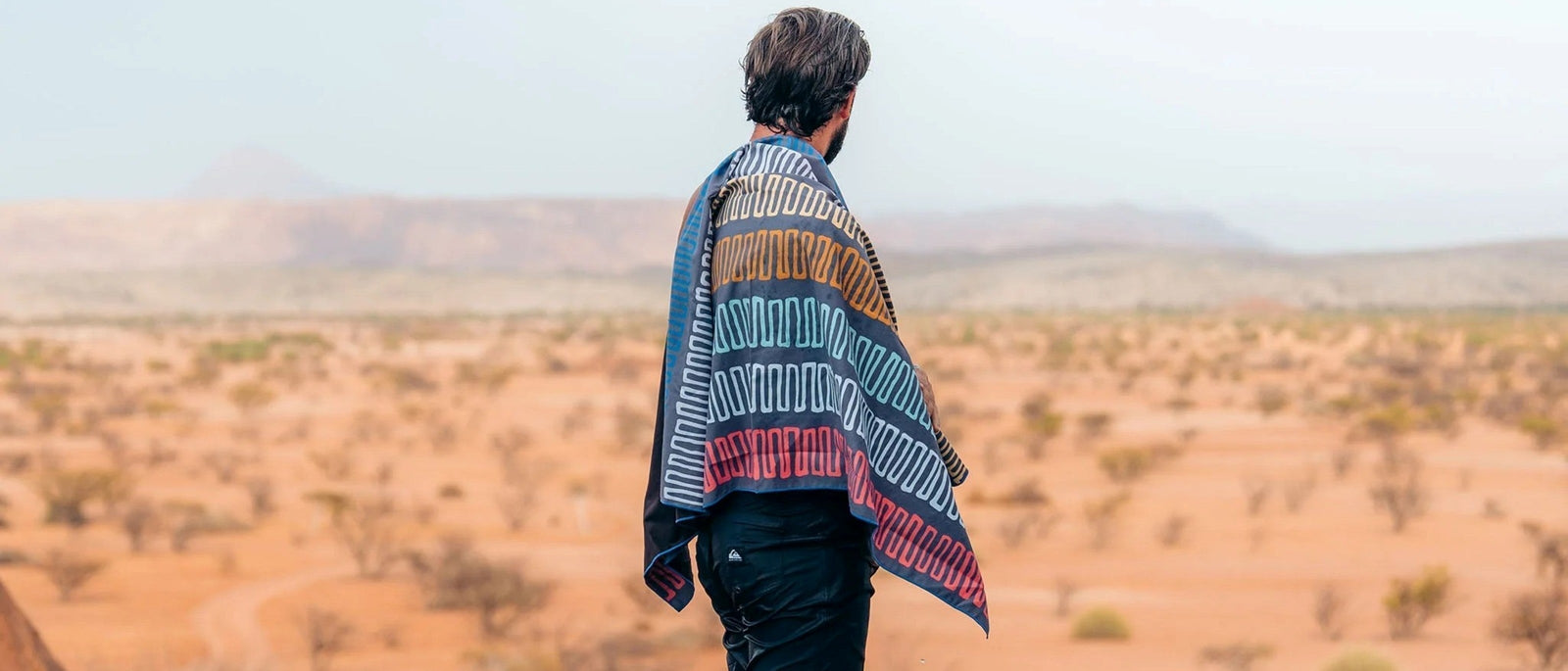
    A man wrapped in a striped Nomadix Ultralight Towel in the Switchback Multi colourway looks out over a red desert landscape with distant hills
    Nomadix | The Story

    How a smoke-billowing '98 Subaru Outback, a month without a shower and a minimalist mantra turned into one of the most travelled towels in America.

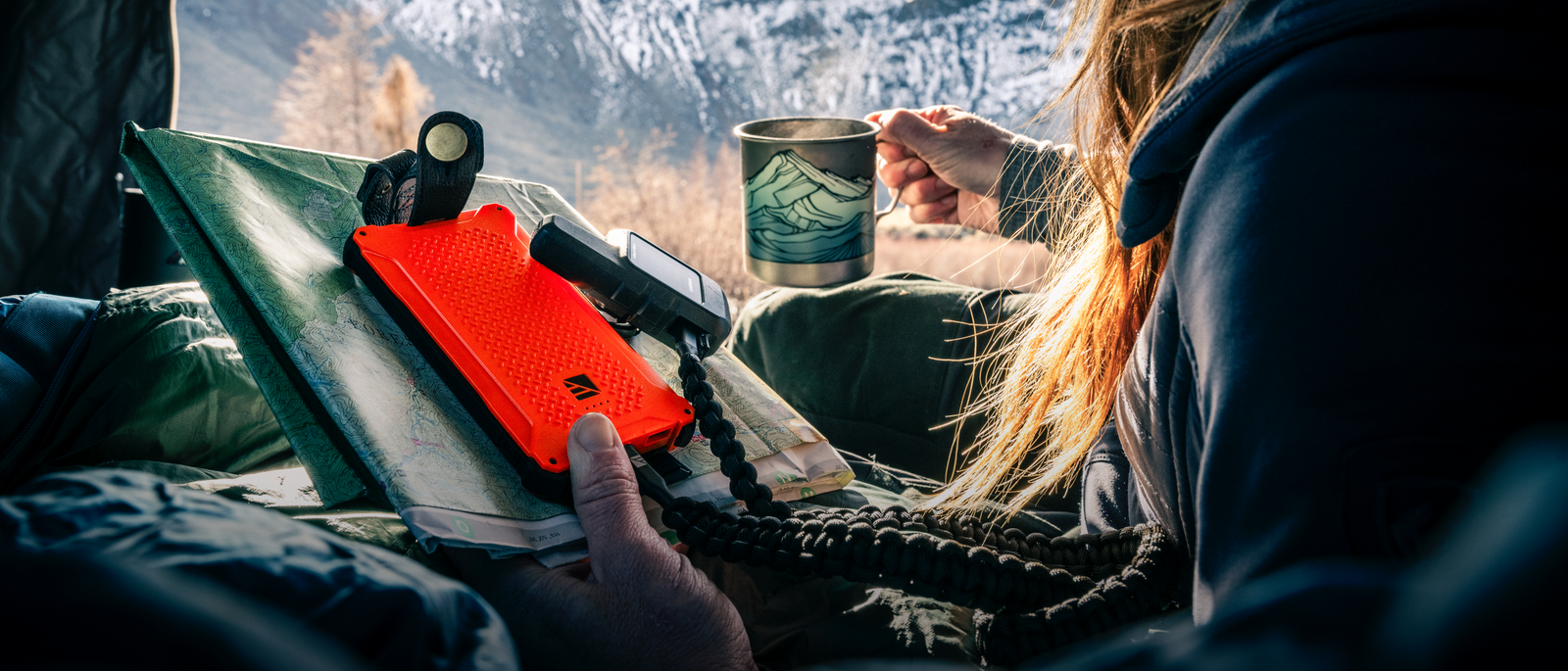
    An orange Dark Energy Poseidon power bank resting on a topographic map inside a tent, with snow-capped mountains outside
    L'énergie noire | L'histoire

    Lorsqu’une partie de chasse à l’arc en solitaire dans l’arrière-pays de l’Utah s’est soldée par un sac rempli d’appareils électroniques hors d’usage, un ingénieur a estimé que le secteur des batteries portables posait un sérieux problème – et a décidé de s’attaquer lui-même à ce problème.

    Best of the US | All-American Outdoor Kit
    Best of the US | Kit de plein air américain

    Le meilleur de nos marques en provenance directe des États-Unis, avec des marques classiques telles que Filson et Pendleton, ainsi que du matériel de plein air de pointe de Sierra Designs, NEMO Equipment et bien d'autres encore.